

Midweek in a café in Drumcondra, I met with Timmayo Thumra, a PhD student at the School of Law and Government, Dublin City University (DCU). It is crunch-time and a big deadline is approaching!
Her thesis is focused on issues of state-making, armed-conflict and transborder identities. She has been working closely with Tangkhul (tribe) Naga community in Myanmar and India, and her research hopes to shine light on contested spaces and issues of ethnicity and identity.
I sense her excitement as she tells me how she’s getting on.
What brings us together is Timmayo’s work as a research assistant at DCU’s Centre for Religion, Human Values & International Relations where, alongside Prof. Philip McDonagh, the director of the centre, a 2-year study aims to improve food security in Malawi, one of the poorest countries of our world.
Nearly 80% of Malawians depend on agriculture making hundreds of communities extremely vulnerable to climate shocks like floods and droughts. The research is focused on regenerative agriculture and giving households the training to produce more diverse food for vital vitamins and nutrition in their diets.
This project not only is tackling hunger but is empowering communities to channel income in other areas to improve their lives.
In partnership with the Jesuit Centre for Ecology & Development (JCED), the Jesuits are working closely with village and faith leaders not only driving data collection but inspiring ecological transformation across communities. (You can find out more about the research: here)
An Unforgettable experience:
Over coffee I caught up with Timmayo on her return from Malawi. Just like me, visiting ‘the warm heart of Africa’ was unforgettable.
“I was really impressed, honestly’ she tells me talking about JCED’s relationship with marginalised communities. “They are so in touch with the people and at the grassroots … Field visits I couldn’t do it without them’ Timmayo explained.
In Phalombe, Timmayo had to set up an office base there and the first step was to seek permission and buy-in from the district office. This meant presenting the research proposal and scope of the project over two sessions.
“There were lots of questions, but what was really interesting was feedback from the commissioner … he took note personally saying he wanted one of these gardens also so that ‘my wife doesn’t have to keep asking for money for vegetables at the market!’
In Malawi a meal basket of vegetables could be between 200-400 Kwacha which is really expensive. The garden project is about building self-sufficiency among small-hold farmers so that income can be spent elsewhere from children’s education to expanding farming.
“Just in terms of my firsthand time in Malawi … and I’m also coming from India, like from a region which is more or less neglected like in terms of development and when I put that in contrast with Malawi – there’s still a stark difference” she adds, meeting my eyes as I look up from my notepad.
“It’s way way worse” she continues solemnly, “when you see it in person – it’s not acceptable. It’s really beyond belief. You come across people and you find that they haven’t actually eaten for a day or two and this is not a rare thing … people going days without any food in their stomachs. This is the qualitative side that you see in the statistics”
“The poverty there is not acceptable”
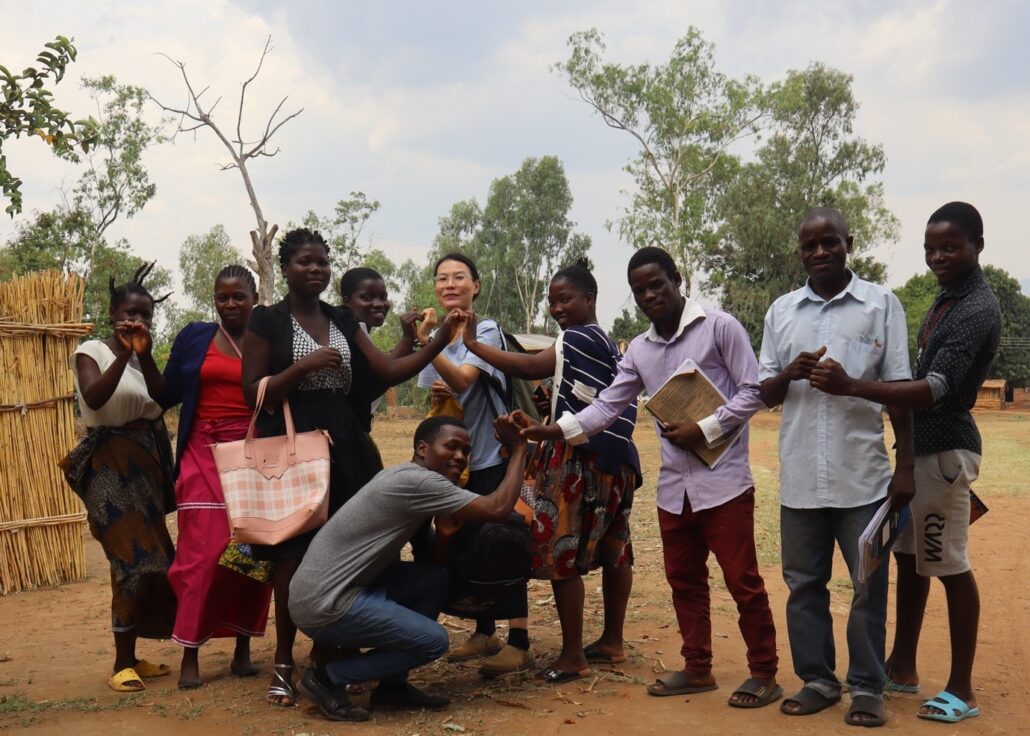
Data collection meeting with field research team in Muloza parish situated between Phalombe and Mulanje districts.
Being a part of the community:
Timmayo lived alongside the communities for 2 months and coordinated farming workshops and community meetings alongside JCED, village chiefs and multi-faith leaders. In Phalombe especially she got really close with the villagers there.
Phalombe is one of the most marginalized areas of the country. The devastating cyclone and its destruction is still felt today with continued extreme weather worsening situations for farmers.
“People there have seen a lot” Timmayo explains, sharing stories of loss and trauma I had heard firsthand too.
She describes the frustrations farmers have in just protecting their crops from livestock and animals. Fences are blown down by fierce winds and raw materials needed to secure and mend fencing aren’t there.
What is participation like? What reaction has the project got from people? I asked.
Overall, the project has been really positive with faith leaders driving momentum for the gardens, what is central to the project is moving people away from handouts and dependency – the trainings and gardens build sustainable livelihoods.
“It’s not we go in as an NGO and tell them this way and the other … it’s input from everyone. It’s within themselves” she adds.
I ask Timmayo about the highlights of her trip and she smiles.
“For me personally, we are working on the area of food security and there’s a lot of need there but it was very heartwarming, I received a lot of gifts in the form of food. They offer food while I am there. They would bag dried cassava for me to take home. They’ve given me mangos … even a live chicken!” She laughs at that before continuing.
“The people are so generous with the little they have and I think what they appreciate and what maybe we need to understand is they really value what JCED and our field workers are doing– that you are really ‘walking the walk’. You don’t just come once and disappear or show up after 6 months” She explains.
“That really encourages them”
Timmayo explains that already at just beyond the halfway point of the project, there is great impact. Green vegetable consumption is rising and varieties of crops also all rich in vitamin A. In addition, the gardens are producing surplus which families can sell.
“It’s really encouraging – people can see the value of it”.
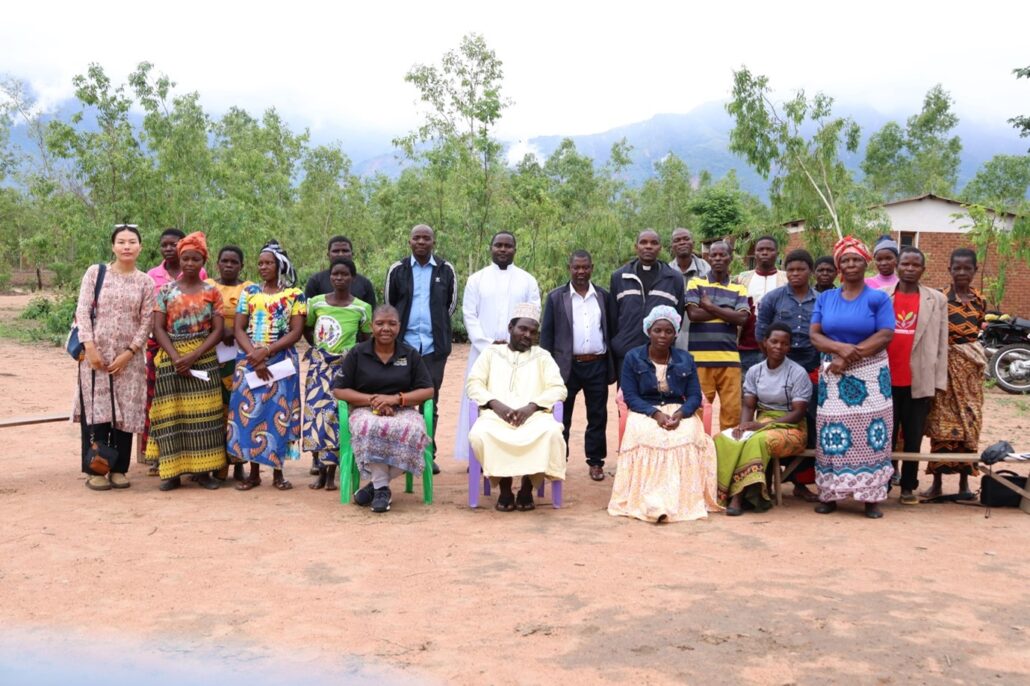
Victory Garden workshop with district officers, faith leaders and traditional chiefs in Phalombe district.
Working side by side:
I asked Timmayo about her experience with JCED and collaboration with the team.
“I really like the way they understand the field workers. It’s really difficult to be on the ground doing that work and look out for them. In terms of interfaith, for me – it was very eye-opening”
She went on to explain how she presumed that interfaith dialogue was already there but when gathered with faith leaders from different dominations from all these small villages brought together, “they themselves recognized the positive aspect of the project bringing faith communities together in this way”
“The importance of bringing faith leaders together was that they were crucial in changing mindsets”
Timmayo spoke of one example where a village questioned ‘why are we doing this catholic thing? What the Catholics are telling us?’
“This went around the village, gossip like this … and what was great is we didn’t have to do anything at all. It was the faith leaders who stepped up to make villages understand why despite differences the project is bringing people together”.
“The message that we are all in this together despite differences – the human element working side by side and working with in solidarity for a common cause was the crucial ingredient here for long-term change”
“It was an amazing experience but sobering too. It humbled me.
Being on the ground made a real difference. Reading the literature and research is one thing but you can go in with the assumption ‘why haven’t these places developed?’ but then you see it for yourself – it’s not easy. Basic tools and equipment aren’t available, or damage from extreme weather but people are overcoming challenge after challenge.
They are inspiring”.
You can find out more about the amazing work happening in Malawi, here
And for more on our climate projects, visit: Care For Our Common Home
Thank you, Timmayo for sharing your experience with us
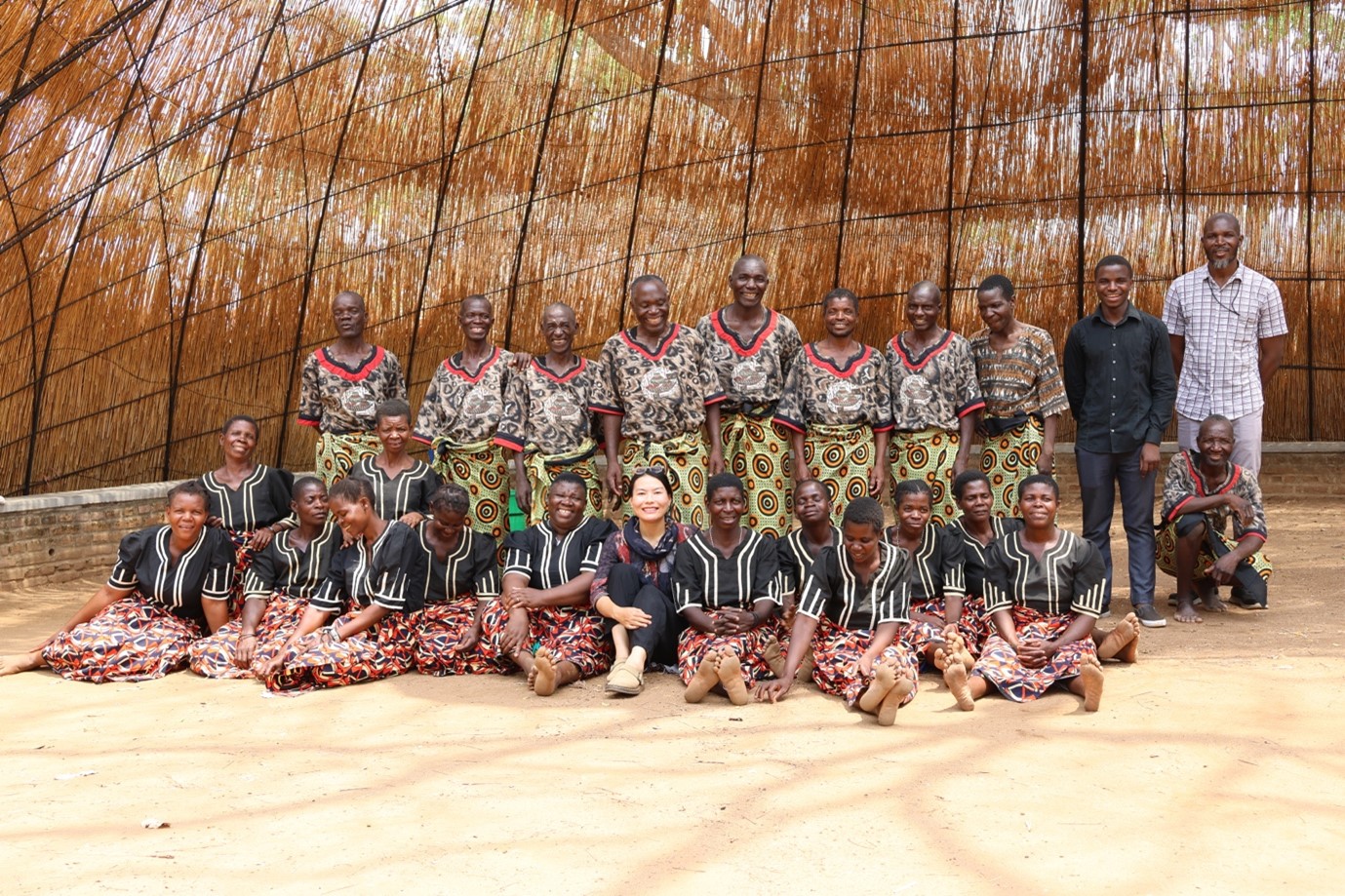
Featured photo: Timmayo with cultural troupe in Kungoni Centre of Culture and Art, Mua Mission, Dedza district.